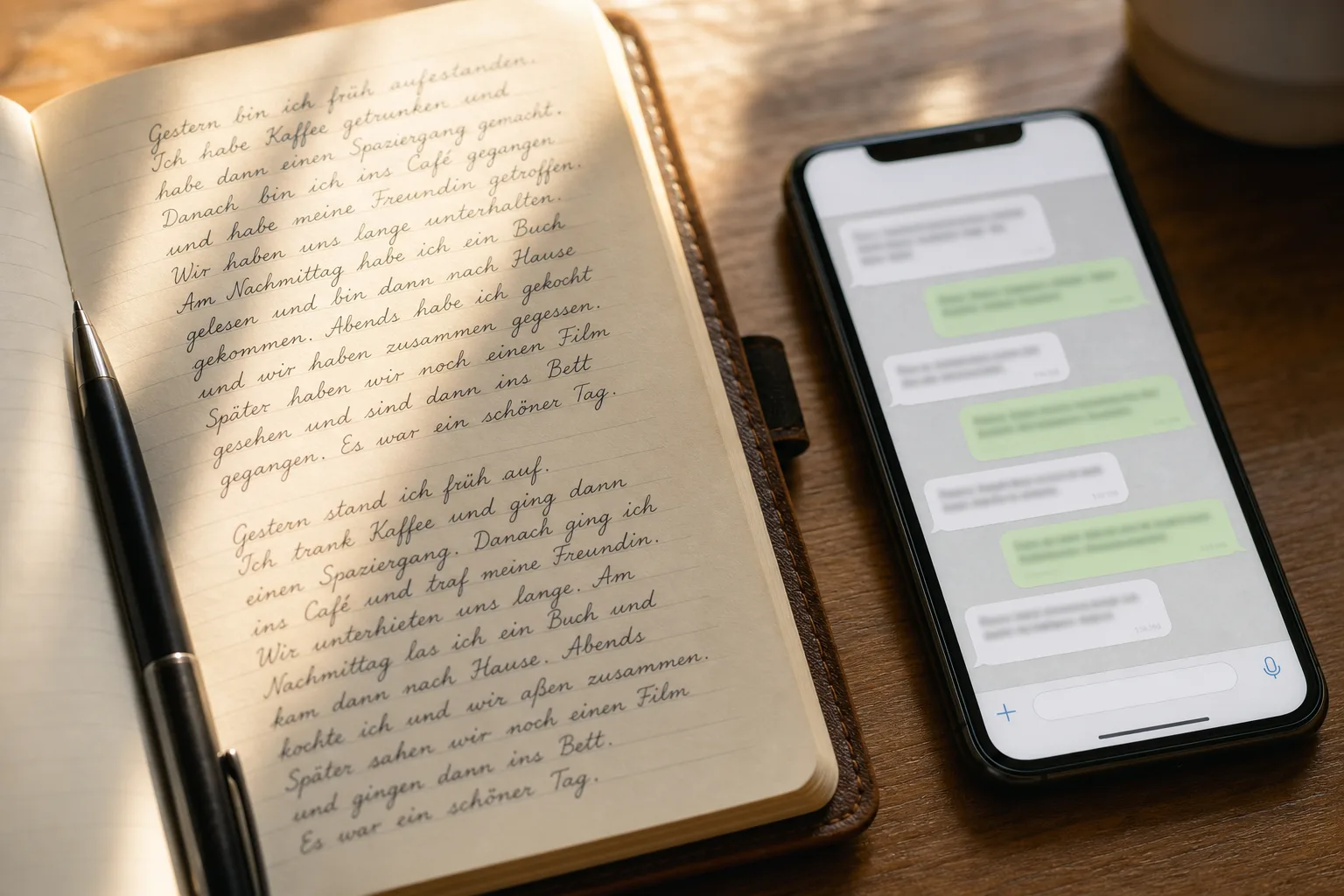
Perfekt vs Präteritum: which German past tense should you use?
2026-07-30
English mostly uses one everyday past (I went, I saw). German learners meet two: Perfekt and Präteritum. Both can translate the same English sentence—so which should you practise?
The short answer
- Spoken German (especially south of Germany, Austria, Switzerland): prefer Perfekt for most verbs.
- Written stories, news, reports: you will see lots of Präteritum.
- sein, haben, and modal verbs: use Präteritum even in conversation (ich war, ich hatte, ich konnte).
If you only remember one rule for speaking: sein/haben/modals → Präteritum; most other verbs → Perfekt.
Perfekt: the everyday past
Perfekt is built with sein or haben + a past participle:
- Ich bin nach Hause gegangen. — I went home.
- Sie hat einen Kuchen gemacht. — She made a cake.
This is what you hear in cafés, chats, and voice messages. It is also what beginners should drill first for storytelling about their own life.
Präteritum: reading past and “helper” verbs
Präteritum looks closer to English simple past for many irregular verbs:
- Ich ging nach Hause.
- Sie machte einen Kuchen.
You need it to read novels, Wikipedia, and newspapers—and you need it orally for:
- Gestern war ich müde.
- Wir hatten keine Zeit.
- Ich wollte kommen.
Same meaning, different register
These often mean the same thing:
- Gestern bin ich spät gekommen. (natural speech)
- Gestern kam ich spät. (more written / narrative)
Neither is “wrong.” Choosing poorly just makes you sound like a textbook—or like a novel in a bakery.
What to practise on Blebber
- Build fluency with Perfect sentence drills.
- Learn the written and modal patterns in Preterite.
- Use Review for forms you keep missing so they return on a schedule.
A simple speaking strategy
When you talk about yesterday:
- Start with sein/haben/modals in Präteritum.
- Use Perfekt for actions (gemacht, gesehen, gegangen).
- Add one time word (gestern, letzte Woche) so the past is obvious.
You do not need perfect literary style to be understood. You need the tense Germans expect in that situation—and enough reps that the choice becomes automatic.