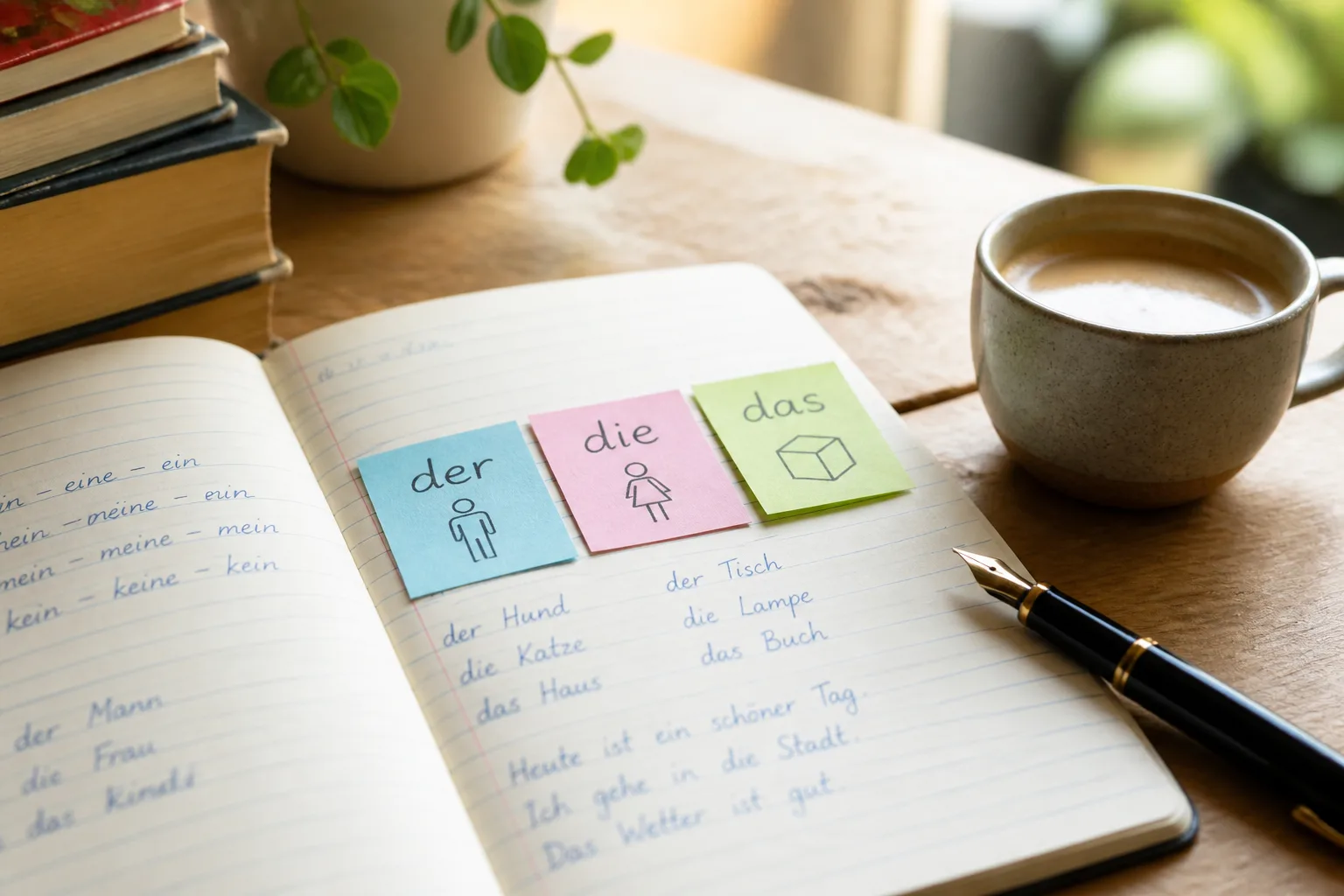
Der, die, das: how to learn German articles without guessing
2026-07-28
If you are learning German, articles feel unfair. English has the. German has der, die, and das—and they change with case. The good news: you do not need to “feel” gender. You need a habit.
Learn the noun with its article
Never memorize bare words like Haus or Tisch. Memorize:
- das Haus (house)
- der Tisch (table)
- die Tür (door)
Say the article out loud every time. If you only know the noun, you will guess forever in sentences.
Colour-code while you study
A simple system helps:
- der → blue (masculine)
- die → red (feminine)
- das → green (neuter)
Use it in notes, flashcards, and vocab lists. Your brain loves patterns even when the language looks chaotic.
Patterns help—but exceptions win until A2
There are useful tendencies (-ung nouns are usually die, -chen diminutives are usually das), but beginners waste time hunting rules for every word. For A1–A2, article + noun pairs beat incomplete rules.
Drill gender on purpose
Reading alone is not enough. You need quick checks:
- See the English meaning and the German noun.
- Choose der / die / das.
- Hear the full phrase and say it aloud.
That loop is exactly what Blebber’s lesson Vocab tab is for—word lists tied to grammar topics, plus gender practice that saves your weak spots for review.
Put articles into real sentences
Once a word is “known,” force it into a short sentence:
- Das Haus ist groß.
- Ich gehe zum Bahnhof. (zu + dem → zum)
Articles are not decoration. They unlock cases, adjectives, and natural speech.
A weekly habit that works
- 10 minutes: gender drill on one lesson’s vocab list
- 10 minutes: sentence practice from that same lesson
- 5 minutes: review anything you missed
Consistency beats marathon study sessions. German gender is learnable—just not by hoping the right article will appear when you need it.