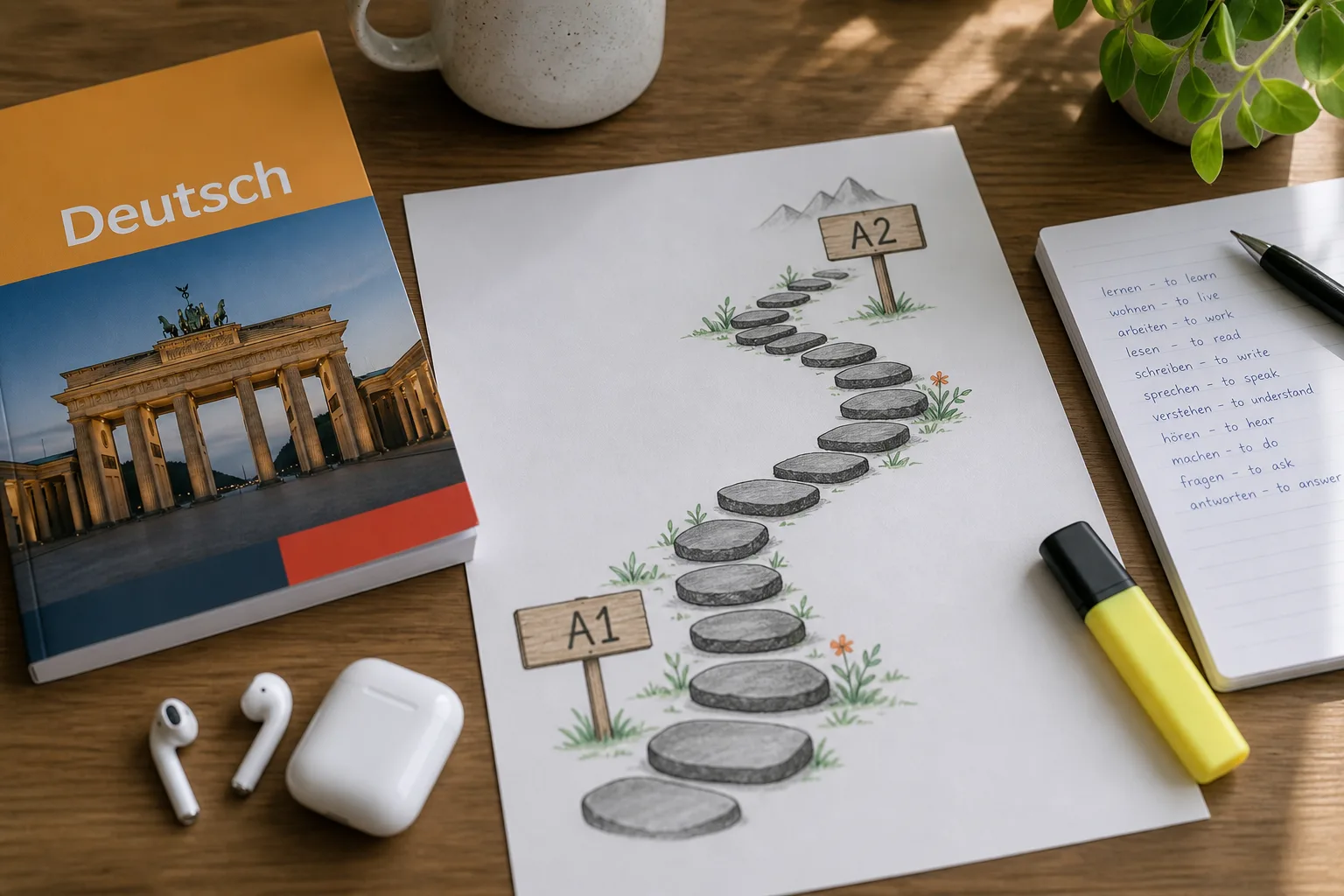
An A1–A2 German learning path for English speakers
2026-07-25
Many learners open a grammar menu alphabetically and start with Adjective or Genitive because those words look important. Then they burn out. German gets easier when topics arrive in an order that matches how you actually build sentences.
Start with sentences you can say today
A1 foundations
- Present — everyday verbs and word order
- Pronouns — ich, du, er/sie/es…
- Plural — die Häuser, die Bücher
- Prepositions — in, auf, mit, nach in real places
- Adjectives — describing things without drowning in endings yet
- Conjugation — irregular and modal patterns you hear constantly
This sequence gets you to: Ich wohne in Berlin. Wir gehen zum Bahnhof.
Then unlock the cases that show up everywhere
A2 expansion
- Dative — giving, helping, thanking, mit dem Bus
- Perfect — talking about yesterday in normal speech
- Future — werden + infinitive and present-with-time-words
- Preterite — reading past tense and spoken war/hatte/wollte
- Passive — wird gemacht in signs and news
- Genitive — later, mostly for reading and formal phrases
You do not need genitive to order coffee. You do need dative and Perfekt.
Pair every grammar topic with three activities
For each lesson:
- Read the explanation once, with examples out loud.
- Translate drills until the pattern feels familiar.
- Vocab + gender for nouns that appear in that topic.
Then speak. Grammar without conversation stays fragile.
Use conversation scenarios early
Do not wait until you “finish grammar.” After a few A1 lessons, practise:
- People / introductions
- Café
- Travel
- Shopping
Short, messy conversations teach retrieval better than silent perfection.
A weekly rhythm that compounds
| Day | Focus |
|---|---|
| Mon–Tue | One grammar lesson + practice tasks |
| Wed | Vocab / gender for that lesson |
| Thu | Conversation scenario (10–15 min) |
| Fri | Weak-spot review of misses |
| Weekend | Light reading or listen-and-repeat |
Miss a day? Restart with review, not guilt.
Follow a path instead of a pile
Blebber’s learning path orders these topics A1→A2 and shows what is next. The full grammar menu stays available when you want to browse—but beginners usually need a guide more than a catalogue.
German is big. Your study plan does not have to be. One clear next lesson beats twelve open tabs.